President: Kerstin Treydte
(Emailcl@egu.eu)
Deputy President: Gabriele Messori
(Email)
ECS Representative: Shalenys Bedoya Valestt
(Emailecs-cl@egu.eu)
The Division on Climate: Past, Present & Future (CL) is one of the larger divisions of the European Geosciences Union. It pools from many disciplines and consequently has many co-organised sessions with other divisions at the EGU General Assembly. The division is very interdisciplinary and covers climate variations on all time scales. CL includes the study of any kind of climate archive from rocks to ocean cores, speleothems, ice cores, chronicles, to instrumental records to name a few. Besides observations, climate modelling on all time scales from the deep past to the future are areas covered by the division. Any aspect of the climate system falls into the realm of the division e.g. atmosphere, ocean, biosphere, cryosphere, and geology. Themes focus on the climate on Earth but may also expand other planets or the Sun.
Latest posts from the CL blog
Winds of change – How can we reconstruct the directions of winds in the past?
Invited guest from the EGU 2025 Outstanding Student and PhD candidate Presentation (OSPP) Award Wind is not easily visible. On historical time scales, its directions and velocities have been measured and recorded by instruments. To some degree, these parameters can also be simulated by climate models. But how about winds in the more distant past? And why would we want to know about them? In many places, wind has been a key agent in shaping the development of landscapes. This …
Read more
When a major climate event goes almost unnoticed: the elusive 8.2 ka signal in southern France stalagmites
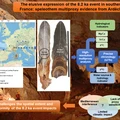
Around 8,200 years ago, the climate of the Northern Hemisphere experienced an abrupt disturbance. In Greenland ice cores, the signal is unmistakable: a rapid drop in temperatures, followed by a gradual return to previous conditions. This episode, which lasted about 150 years, is known as the 8.2 ka event (“ka” meaning thousand years before 1950). It is often described as the most prominent climate perturbation of the Holocene (the last ~11,700 years). The widely accepted explanation involves a massive release …
Read more
When European pollution reshaped the Asian summer monsoon
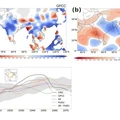
The Asian summer monsoon is one of the most powerful climate phenomena on Earth. Each year, it brings life-giving rainfall to billions of people across South and East Asia. Its arrival determines harvests, water supply, food security, and economic stability. We often think of the monsoon as something driven locally: by the heating of the Indian subcontinent, by ocean temperatures, or by regional pollution. But what if part of its history was shaped thousands of kilometres away? In our recent …
Read more

Inside the Baltic Sea N2O Hunt: Tracing Sources using Isotopic tools
Nitrous oxide (N2O), commonly known as laughing gas, is one of the most important greenhouse gases, and its rise in the Anthropocene significantly contributes to global warming and depletion of stratospheric ozone. The marine environment, especially coastal and marginal seas, is an important (about 25%) contributor to the global atmospheric source of N2O. Nitrous oxide is primarily produced in marine systems by special microbes – the nitrifiers and the denitrifiers. In oxygenated waters, the nitrifiers produce N2O as a byproduct …
Read more
Recent awardees

The 2026 Hans Oeschger Medal is awarded to
Friederike E.L. Otto for pioneering extreme event attribution and transforming climate communication through the World Weather Attribution initiative.
Read more

- 2026
- Division Outstanding Early Career Scientist Award
The 2026 Division Outstanding Early Career Scientist Award is awarded to
Marlow Julius Cramwinckel for innovative contributions to the combination of climate reconstructions and modelling to constrain climate, carbon cycle, and hydrological feedbacks in the past.
Read more

The 2025 Hans Oeschger Medal is awarded to
Heather Marie Stoll for pioneering contributions in both marine and terrestrial palaeoclimate research, which led to groundbreaking advancement in our understanding of rapid climate change, through forcings and feedbacks.
Read more

- 2025
- Milutin Milanković Medal
The 2025 Milutin Milanković Medal is awarded to
Zhengyu Liu for outstanding contributions to our understanding of global climate change by combining theoretical approaches, the development and use of a hierarchy of models, and model-data comparisons.
Read more

- 2025
- Division Outstanding Early Career Scientist Award
The 2025 Division Outstanding Early Career Scientist Award is awarded to
Kai Kornhuber for outstanding research on extreme weather and climate dynamics, including circumglobal patterns in the jet stream, their relation to heatwaves and food security, and representation in climate models.
Read more

- 2025
- Outstanding Student and PhD candidate Presentation (OSPP) Award
The 2025 Outstanding Student and PhD candidate Presentation (OSPP) Award is awarded to
Devika Moovidathu Vasudevan Upper Tropospheric Humidity and Cloud Radiative Forcing: A Tropical Perspective
Read more

- 2025
- Outstanding Student and PhD candidate Presentation (OSPP) Award
The 2025 Outstanding Student and PhD candidate Presentation (OSPP) Award is awarded to
Lison Soussaintjean Towards understanding the N2O production in dust-rich Antarctic ice
Read more

- 2025
- Outstanding Student and PhD candidate Presentation (OSPP) Award
The 2025 Outstanding Student and PhD candidate Presentation (OSPP) Award is awarded to
Ramona Schneider Magnetic fabric of Tajik loess-palaeosols as a palaeowind and process indicator
Read more

- 2025
- Outstanding Student and PhD candidate Presentation (OSPP) Award
The 2025 Outstanding Student and PhD candidate Presentation (OSPP) Award is awarded to
Tatiana Bebchuk Subfossil yew (Taxus baccata) wood from eastern England reveals mid-Holocene climate and environmental changes
Read more
Current issue of the EGU newsletter
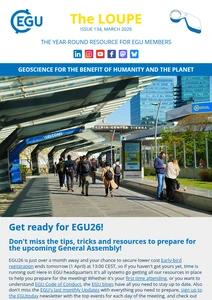
In our March issue, we are preparing for the annual General Assembly on the EGU blogs and with a special webinar to help all EGU26 attendees refresh their knowledge of the meeting we are all systems go here in EGU HQ! Also learn about what it's like to spend 25 years working with Interactive Open Access publishing, don't miss out on science for policy events at EGU26, and the EGU awards and medals are now open for nominations - the process is probably easier than you think!
All this and much more, in this month's Loupe!
Read more