Science for policy resources you can watch and read, and opportunities that you can apply for!
Issue 68, October 2026

Dear EGU Expert,

This month’s Science for Policy Newsletter invites you to take a look at the recent EGU webinar on building science-policy dialogues and the Handbook on Science Sparring by the Finnish Academy of Sciences and Letters. It also highlights EU-level traineeship opportunities at the Joint Research Centre, and at the European Parliament, as well as the opportunity by the Consolidating European Science Diplomacy (CUSP) project to join a working group to contribute to the European Framework for Science Diplomacy.

If you have any further questions or comments about the policy opportunities that exist for scientists in Europe, don’t hesitate to get in touch via policy@egu.eu.

Best wishes,
EGU's Science for Policy Team

WATCH THE EGU WEBINAR ON SCIENCE-POLICY DIALOGUE

EGU webinars are hosted throughout the year and allow EGU members to learn about EGU activities and develop science-related skills. These webinars often have synergies with science-policy topics. The recording of the webinar Beyond SciComm 101: Building Environmental Science-Policy Dialogue – Is Science Up For Negotiation? featuring Axel Eriksson, one of the fourteen members of the UN Secretary-General's Youth Advisory Group on Climate Change, is now available to watch on the EGU's YouTube channel.

During the webinar, Eriksson provides participants with insights on science-policy dialogue in the context of multilateral environmental negotiations, giving examples of environmental negotiations and discussing different ways for scientists to engage with them. You can view the full recording here.

CHECK OUT THE HANDBOOK ON SCIENCE SPARRING

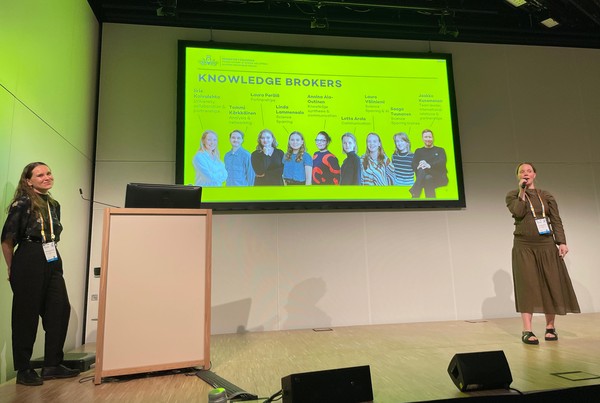
Science for Policy Award Lecture by the Finnish Academy of Science and Letters, EGU26

Science Sparring is a knowledge brokering method developed by the Science for Policy Team at the Finnish Academy of Science and Letters, the recipients of the 2026 EGU Science for Policy Award. The method aims to fill knowledge gaps early in the legislative process by inviting researchers to critically review policy drafts. 

Their recently published Policy Red Teaming: A How-To Guide on Science Sparring outlines how to facilitate a Science Sparring session, concrete Science Sparring examples, and tools for knowledge brokers, researchers, and policymakers.

You can also learn more about the work of the Finnish Academy of Science and Letters in this brief interview with two of their team members, Linda Lammensalo and Iiris Koivulehto.

APPLY FOR TRAINEESHIP OPPORTUNITIES WITHIN EU INSTITUTIONS

The net-zero JRC building in Seville, Spain

Traineeships offer a great path for scientists to get introduced to the work of the EU institutions. Below are two opportunities currently open at the Joint Research Centre of the European Commission and the European Parliament. Both opportunities are paid and highly competitive.

Scientific Traineeships at the Joint Research Centre

The Joint Research Centre of the European Commission has an open call for the March 2027 cohort of its Scientific Traineeships Programme. The organisation seeks to hire approximately 50 trainees across five JRC sites in Belgium, Italy, Germany, the Netherlands, or Spain. 

The traineeship programme prioritises candidates with a scientific background. Environment and climate, energy sustainability, and data analysis for evidence-based policymaking are among the priority areas. This is a great opportunity for early-career researchers interested in policy impact to acquire practical skills in an interdisciplinary environment and to develop a larger policy network.

Learn more here and apply by 28 October 2026, 15:00 (CET).

Schuman Traineeships at the European Parliament

Schuman Traineeship programme provides an insight into the work of the European Parliament. The applications are currently open for the March-July cohort. The traineeships can be undertaken at one of the European Parliament’s official places of work – Brussels, Luxembourg and Strasbourg – or in its Liaison Offices in the Member States.

The application deadline is 31 October 2026, midnight (CET). You can see the specific traineeship offers here, and read more about the application procedure here. 

OPPORTUNITY TO SUPPORT EUROPEAN SCIENCE DIPLOMACY AT CUSP

Join a Science Diplomacy Working Group

Consolidating European Science Diplomacy (CUSP) is a Horizon Europe project that aims to enable seamless interaction among science, diplomacy, and policy. The project is now inviting researchers, policymakers, and practitioners to join one of its ten thematic Working Groups.

The application to join one of the Working Groups requires registering for the Science Diplomacy Hub. Each group will bring together around 20–30 members to exchange expertise, build connections, and co-develop recommendations and outputs that support the implementation of the European Framework for Science Diplomacy. Applications are welcome from all career stages and backgrounds. 

You can read more about the Working Groups here, and the full terms of reference on CUSP’s LinkedIn page. The applications close on 11 November.

Learn more about Science Diplomacy 

The recently published, open-access Palgrave Handbook of Science Diplomacy discusses science diplomacy in the light of geopolitical rivalry, rapid technological change, and fragmented global governance. While it is more theoretical, it's a great resource for researchers wanting to learn more abot science diplomacy before or while engaging with it.  

©2026 European Geosciences Union. All rights reserved.
Our mailing address is:
EGU - European Geosciences Union e.V.
Kastenbauerstr. 2
81677 Munich, Germany
Banner image credit: European Union 2015 – European Parliament via Flickr