


- 26 November 2025
The full results of the Union’s autumn 2025 election are now available.
European Geosciences Union
www.egu.euThe full results of the Union’s autumn 2025 election are now available.
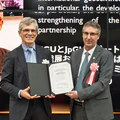
The European Geosciences Union is honouring 52 people at all stages of their careers who have made substantial contributions to the Earth, planetary, and space sciences.
The European Geosciences Union (EGU) is excited to announce this year’s Science Journalism Fellowship awardees: Tim Hornyak, Marta Abbà, and Alejandro Munoz
Following a vote by EGU’s volunteer Council, the EGU has adopted a new comprehensive emergency support policy that will provide greater access to all EGU's scientific tools, resources and opportunities to any researcher in the Earth, planetary and spaces sciences, anywhere in the world, who is impacted by disaster, crisis or conflict.
Applications are now open for experienced attendees to apply to be a part of the EGU26 Peer Support programme. The Peer Support programme, formerly called the mentoring scheme, helps experienced attendees of the General Assembly to facilitate novice attendees in getting the most out of their experience during the week of the meeting. Submit your application by 31 March 2026.
Dr. Dominik Stolzenburg is a chemist in atmospheric physics at TU Wien, specializing in aerosol science and air quality. His work focuses on how ultrafine particles form, transform, and affect both climate systems and human health — especially in cities. Through field measurements, modeling, and data analysis, he explores how human and natural emissions interact, helping policymakers shape cleaner, evidence-based environmental strategies. Today, we’re speaking with Dr. Stolzenburg about the invisible but powerful role of aerosols in our atmosphere — …
38 years ago, representatives from 46 countries around the globe came together to find a solution to the climate crisis. Alerted to an issue discovered by scientists 13 years previously, the representatives of these nations worked together swiftly and with purpose to create an international treaty to combat a major environmental issue. The treaty was signed by all 46 participant nations and would later go on to be one of the few universally ratified treaties, with all 198 UN nations …
This blog post is part of our series: “Highlights” for which we’re accepting contributions! Please contact Emma Lodes (GM blog editor, elodes@asu.edu), if you’d like to contribute on this topic or others. Interview with Kate Drobnich, PhD student, Department of Geosciences, Colorado State University. Email: kate.drobnich@colostate.edu. Questions by Emma Lodes. Can you briefly describe the main objective of your research on Puerto Rico? I am working on a topographic escarpment in Puerto Rico to determine the roll of sediment caliber …